Preview

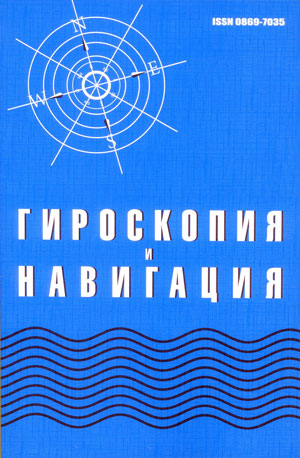
Giroskopiya i Navigatsiya

Advanced search

Since 2010 the English version of the journal Giroskopiya i Navigatsiya - Gyroscopy and Navigation has been published (print version ISSN 2075-1087, online version ISSN 2075-1109). 

Gyroscopy and Navigation is a peer-reviewed journal that covers the following subjects: 

- inertial sensors, 
- navigation and orientation systems; 
- global satellite navigation systems; 
- integrated INS/GNSS navigation systems; 
- navigation in GNSS-degraded environments and indoor navigation; 
- gravimetric systems and map-aided navigation; 
- hydroacoustic navigation systems; 
- spacecraft navigation and motion control; 
- navigation devices and sensors (logs, echo sounders, magnetic compasses); navigation and sonar data processing algorithms. 

Gyroscopy and Navigation publishes manuscripts originally submitted in English and translated works. 

The peer review policy of the journal is independent of the manuscript source, ensuring a fair and unbiased evaluation process for all submissions. The journal welcomes submissions in English from researchers worldwide.

The journal is distributed by SpringerNature. Gyroscopy and Navigation is abstracted/indexed in SCOPUS, Astrophysics Data System (ADS), Baidu, CLOCKSS, CNKI, CNPIEC, Dimensions, EBSCO, EI Compendex, Google Scholar, Japanese Science and Technology Agency (JST), Naver, OCLC WorldCat Discovery Service, Portico, ProQuest, SCImago, TD Net Discovery Service, Wanfang, eLibrary.ru.

Current issue

Vol 33, No 4 (2025)
3-46 166
Abstract

Fiber optic gyroscopes are one of the main categories of optical gyroscopes, finding wider applications in inertial sensing and navigation through the measurement of angular velocity. Over the past few decades, the research on fiber optic gyroscopes competes with the state-of-the-art technologies in every aspect of its design based on different applications. Though the concept of optical gyroscopes started to unfold a century back, research on this is blooming to find the alternative strategy in structure for one another, with a range of classified designs and performance improvement techniques to work on. Among the types of fiber optic gyroscopes, the interferometric type finds place in most of the navigation applications in land, military, avionics and marine. The design perspectives include the choice of source, the fiber coiling pattern, the phase modulators, the signal processing techniques and, most prominently, the integrated optics at different levels. This paper presents an exhaustive review on the fiber optic gyroscopes design and development techniques.

47-63 119
Abstract

The paper discusses the data fusion of strapdown inertial navigation system (SINS) accelerometers and gyroscopes and an odometer. Fusion is implemented using threedimensional inertial and kinematic odometer dead-reckoning, and continuous SINS updates by the computed odometer coordinates. Important factors for the integration accuracy are highlighted: misalignments between the SINS instrument frame and the body frame; linear displacements of the SINS center relative to the odometer reference point; odometer scale factor error, and possible timing skew between raw SINS and odometer data. These parameters are included in the estimated variables in the described data fusion algorithms. Based on the results of experimental data analysis, we demonstrate the necessity and efficiency of the proposed algorithmic solutions.

64-77 102
Abstract

Calibration of a strapdown inertial navigation system (SINS) on a simple turntable is considered. SINS calibration is carried out in the autonomous mode, relying only on the SINS sensors. One of the well-known algorithms for calibration in this scenario is the algorithm based on the extended Kalman filter proposed by N.A. Parusnikov. The algorithm is accurate enough, so that under certain assumptions, it is close to optimal. Some difficulties in its application are due to linearization of the problem, which requires the knowledge of initial approximation of the parameters to be calibrated. As an alternative, an algorithm based on the Fourier transform and subsequent transition to data spectrum analysis is proposed, after which the calibration algorithm becomes purely algebraic and does not involve any convergence problems. The accuracy of the proposed algorithm, as well as its nonoptimality are discussed through the comparison with the theoretical Cramer–Rao bound.

78-102 70
Abstract

The paper considers the extended Rao-Blackwellisation method (ERB) proposed by the authors and the ERB-based suboptimal algorithm designed to solve the problem of estimating a variable state vector described by a linear stationary equation using nonlinear measurements within the Bayesian approach. The ERB features and the main stages of designing the proposed algorithm are explained by the example of solving a problem of estimating a Markov process frequently used in processing of navigation information, generated by multiple integration of an input signal in the form of white noise. The effectiveness and advantages of the proposed algorithm in comparison with the conventional Monte Carlo-based algorithm are illustrated by solving the map-aided navigation problem in its simplest formulation. Issues to be further studied, in particular, prospects for the ERB application in solving applied problems of navigation and trajectory information processing are discussed.

103-114 66
Abstract

A comparative analysis has been performed for the algorithms correcting measurements of the navigation system of an autonomous underwater vehicle (AUV) using ranges to acoustic beacons in the case of their unfavorable location relative to AUV. The paper examines a recursive iterative Kalman filter, an iterative batch linearized smoothing filter and an algorithm based on their combined use, and an algorithm based on factor graph optimization methods.

115-128 64
Abstract

The paper presents a cost-effective way to solve the problem of navigation support for a group of autonomous unmanned underwater vehicles (UUV) which do not have expensive accurate time systems and absolute speed sensors. The proposed method is based on the use of an acoustic positioning system (APS) with a short baseline. A method for determining the UUV location is proposed with the coordinates of underwater vehicles being estimated according to their motion model. A short-baseline version of the APS is presented, in which the received signal processing unit for generating the time delay measurements on the UUV additionally measures the received signal frequency. A location estimation algorithm based on a particle filter has been developed for this signal processing unit; it is designed to work on each UUV in real time. The descriptions of the proposed algorithms and the results of computer simulation of their operation are presented.

Information

Announcements

2025-10-01

Семинар журнала: Семинар журнала 15 октября 2025 года

Журнал «Гироскопия и навигация» и Академия навигации и управления движением приглашают на онлайн-семинар 15 октября 2025 г. в 15 ч. 30 мин.

More Announcements...


Creative Commons License
This work is licensed under a Creative Commons Attribution 4.0 License.